

The first time most of us met Alice, she was a curious girl chasing a white rabbit into a hole. A storybook adventure. A children's classic.
That is not what Lewis Carroll wrote.
Alice's Adventures in Wonderland, published in 1865, is one of the most psychologically unsettling books in the English literary canon. It is a story about a child who loses her identity, navigates a world with no logical rules, faces constant threats of death, and cannot find her way home. Disney gave it talking flowers and a catchy song. Carroll gave it existential dread.
Who Are You?
The question the Caterpillar asks Alice early in the book is the one that haunts every page: who are you?
Alice cannot answer. She has changed size multiple times since that morning, been mistaken for someone's housemaid, been confused with a serpent, and been told by multiple Wonderland residents that she is not who she thinks she is. At one point, she sincerely wonders whether she has become a different child entirely and tests herself by reciting her lessons to see if she still knows them.
This is the central dark theme of Alice in Wonderland. Not the Queen of Hearts. Not the Mad Hatter. The terrifying possibility that your sense of self can be taken from you. That you might wake up one day and not recognize who you are. That the world will keep demanding to know who you are, and you will have no answer.
The Tea Party That Never Ends
The Mad Tea Party is widely considered one of the most whimsical scenes in the book. It is actually one of the darkest.
The Hatter and the Hare are trapped. Time stopped for them at six o'clock after the Hatter offended Time himself, and now they are condemned to sit at that table forever, rotating through the dirty cups, making conversation that leads nowhere. The tea party is not a party. It is a prison. A vision of endless, purposeless existence dressed up with tablecloths and teacups.
Carroll, a mathematician and logician by trade, understood absurdism before absurdism had a name. The Mad Tea Party predates Sartre's No Exit by nearly a century, but it describes the same thing: a hell that looks, at first glance, like a minor inconvenience.
Off With Her Head
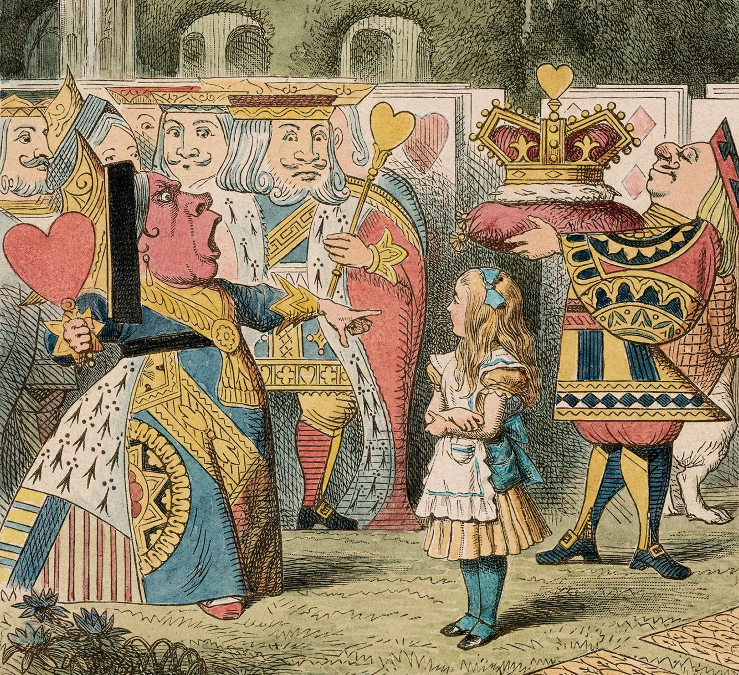
The dark symbolism of Alice in Wonderland is not subtle once you start looking. The Queen of Hearts sentences people to beheading constantly, casually, almost cheerfully. Alice drinks from a bottle that might contain poison. She is threatened, belittled, and dismissed by nearly every creature she meets. The rules of Wonderland change without warning and mean whatever the person in power says they mean.
Carroll was satirizing the Victorian world Alice came from. The adults and authority figures of Wonderland behave exactly as the adults and authority figures of proper Victorian society did: with arbitrary power, pointless ceremony, and no real concern for the child trying to navigate their world.
The Only Honest Character in Wonderland
And then there is the Cheshire Cat.
The Cat is the only resident of Wonderland who tells Alice the truth. He does not trick her, test her, or behead anyone. He simply states what the rest of the book refuses to say out loud: we are all mad here.
This is not a threat. It is a liberation. If everyone in Wonderland is mad, madness is not a deviation. It is the default. The label loses its power. And for a girl who has spent the entire book being told she is wrong, too big, too small, too bold, not herself enough, that is the most radical thing anyone could say to her.
Bring the Tea Party Home
The We're All Mad Here candle is brewed from the scent of that famous table: Earl Grey tea, bergamot, and almond cake. The same spread that trapped the Hatter and the Hare, hand-poured in small batches in Trenton, NJ.
Light it while you read. Or while you sit with the particular kind of madness that comes from feeling like you do not quite fit the world you were handed.
The Cat would understand.
Shop our Alice in Wonderland inspired candle We're All Mad Here
Want more folklore, new scents, and early access to seasonal drops? Subscribe to our newsletter for 15% off your first order.